
Adult mental health
Programs and services
The department supports many programs and services for people living with mental illness. Contact your health care provider, health care plan, county or tribe for more information about services available.
Emergency mental health services are available 24 hours a day, seven days a week.
- Mental health crisis phone numbers are listed by county.
- 988 Suicide & Crisis Lifeline: Call, chat, or text 988
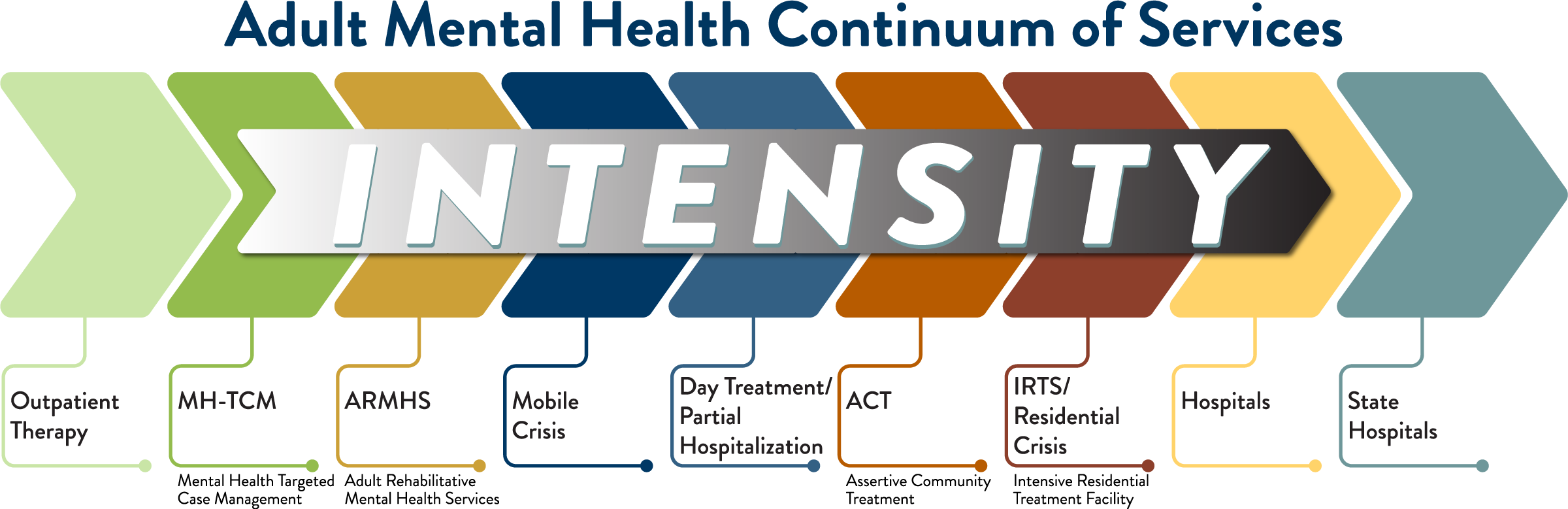
Adult mental health services
Minnesota offers many adult mental health services to help people live, work and stay well in their communities. Services may include counseling, crisis response, employment support, case management, peer support and residential or outpatient treatment. Many programs are available through local providers, counties, clinics and community organizations.
Adult Rehabilitative Mental Health Services
Adult Rehabilitative Mental Health Services (ARMHS) can provide individuals with:
- Basic living and social skills
- Certified peer specialist services
- Community intervention
- Medication education
- Transition to community living
Services are provided at the person’s place of residence.
- How to access ARMHS: See the list of certified ARMHS providers in each county.
- More information about Adult Rehabilitative Mental Health Services.
Certified Community Behavioral Health Clinics
Certified Community Behavioral Health Clinics provide a new way of delivering community behavioral health services. Certified Community Behavioral Health Clinics act as a “one-stop-shop” that offer mental health and substance use disorder services, as well as a range of other services, in order to coordinate care across settings and providers.
To access a Certified Community Behavioral Health Clinic, contact a clinic listed below:
- Alluma
Counties served: Kittson, Marshall, Red Lake, Polk, Norman and Mahnomen.
To contact Alluma, call (218)-281-3940, or visit their website for more information.
- Amherst H. Wilder Foundation
County served: Ramsey.
To contact the Amherst H. Wilder Foundation, call (651)-280-2310, or visit their website for more information.
- Human Development Center
Counties served: Southern St. Louis, Carlton, and Lake.
To contact HDC, call (218) 728-4491 or (800) 412-9764, or visit their website for more information. - Northern Pines Mental Health Center
Counties served: Cass, Wadena, Todd, Morrison, Crow Wing and Aikin.
To contact Northern Pines Mental Health Center, call (218)-829-3235, or visit their website for more information. - People Incorporated
Counties served: Anoka, Washington, Dakota, Hennepin and Ramsey.
To contact People Incorporated, call (612)-230-1300 or (651)-774-0011, or visit their website for more information. - Ramsey County Mental Health Center
County served: Ramsey.
To contact Ramsey County Mental Health Center, call (651)-266-7890, or visit their website for more information.
- Western Mental Health Center
Counties served: Lyon, Lincoln, Redwood, Murray and Yellow Medicine
To contact Western Mental Health Center, call (507) 532-3236 or 1-800-658-2429, or visit their website for more information. - Zumbro Valley Health Center
Counties served: Olmsted and Fillmore.
To contact Zumbro Valley Health Center, call (507)-289-2089, or visit their website for more information.
Assertive Community Treatment
Assertive Community Treatment (ACT) offers intensive services at home for individuals with a serious mental illness. Services are customized to fit each person’s unique set of needs, strengths and preferences. This may include any area affected by the mental illness, including symptom management, employment, housing, finances, education, medical and dental care, substance abuse, family and social life and activities of daily living.
- How to access ACT : See the list of Current approved ACT Teams in Minnesota
- More information about Assertive Community Treatment.
Crisis response
All counties in Minnesota have crisis response teams. A mental health crisis responder assesses the crisis, assists the recipient in coping with the crisis and follows up with the person to assure that they receive longer-term support and services as needed.
- How to access Crisis services: County emergency mental health telephone numbers.
Services include:
- Mobile Crisis Response Services: One or two trained crisis responders who will come to your home or a meeting place that you designate to help you cope,
- Residential Crisis Service: Services in a facility where you can stay for a few days until the crisis is under control, and/or
- Crisis Stabilization service: Services following either Mobile Crisis Response or Residential Crisis Response that help you connect with other service providers and bolster your skills in order to avoid future crises.
- More information about mobile crisis mental health services.
Certified peer specialist
Certified peer specialists are individuals who have a lived experience of mental illness and are trained to be direct service mental health staff. Certified peer specialists are employed by a range of mental health services, offering support and hope to individuals with a lived experience of mental illness by sharing their story and helping them to discover their strengths.
- How to get the help of a peer specialist: Many mental health providers employ peer specialists. Speak with your provider.
- More information about becoming a certified peer specialist.
Day treatment
Adult day treatment is an intensive psychotherapeutic treatment provided with the goal of reducing or relieving the effects of mental illness and providing training to help the person live in the community.
Adult day treatment is a short-term, community-based mental health program consisting of group psychotherapy, rehabilitative services and other therapeutic group services provided by a multidisciplinary team. Adult day treatment services are linked to goals and objectives identified in an individual’s treatment plan, which will lead to improvement in the person’s mental illness.
More information about day treatment.
Dialectical Behavior Therapy – Intensive outpatient treatment
Dialectical Behavior Therapy (DBT) provides intensive outpatient treatment that may involve individual therapy, group skills training, telephone coaching and consultation team meetings. Research has shown that it is highly effective in treating a wide range of mental illness.
- How to access DBT : see the DBT Certified Providers List
- More information about dialectical behavior therapy.
Education and prevention services
Minnesota counties provide information on predictors and symptoms of mental disorders, where mental health services are available and how to access the services. Contact your local county agency or tribe for more information about education and prevention services.
Emergency services
Service is available on a 24-hour, seven-day-a-week basis for people having a psychiatric crisis, a mental health crisis, or emergency. A directory of mental health crisis phone numbers in Minnesota lists all crisis providers by county. The National Suicide Prevention Lifeline is a toll-free number: 800-273-TALK (8255).
Employment services
Most people with serious mental illness want to work. While two of every three people with mental illness are interested in competitive employment, less than 15 percent are employed. Individual Placement and Support (IPS) can help. IPS is a program that supports people with serious mental illness find and keep a job.
First episode psychosis
Psychosis often begins when a person is in their late teens to mid-twenties but can also begin later into adulthood. Psychosis can be a symptom of a mental illness such as schizophrenia or caused by medications, alcohol or drug abuse. When a person experiences psychosis for the first time, it is important that they receive the right care as soon as possible. Psychosis can be treated, and early treatment increases the chance of a successful recovery.
More information about first episode psychosis.
Mental Health – Targeted Case Management (MH-TCM)
Targeted Case Management is a service that helps adults with serious and persistent mental illness get medical, social, educational, vocational and other services related to the person's mental health needs.
How to access TCM: Contact your local county agency or tribe
Outpatient services
Many hospitals and clinics offer outpatient services, which can include: individual, group and family therapy; individual treatment planning; diagnostic assessments; medication management; and psychological testing.
How to access outpatient services: Go to DHS Licensing Lookup. Under License Type, select Mental Health Center/Clinic.
Partial hospitalization program
Partial hospitalization consists of a range of therapeutic services provided by a multidisciplinary staff. Services include individual, group and family psychotherapy, individualized activity therapies and patient training and education. Services may be provided in an outpatient hospital facility or a community mental health center.
How to access partial hospitalization services: People are admitted based on a physician referral.
Residential Treatment Services
Residential treatment services include Intensive Residential Treatment Services (IRTS) and Residential Crisis Stabilization services (RCS) LINK. These services provide a safe and supervised environment in a community based residential program setting.
How to Access Adult RCS and IRTS:
- Hospital emergency departments, mental health therapists and mobile crisis response teams can to provide an assessment and help people decide if RCS services are needed and find the nearest program to meet their needs. Some RCS programs are able to provide the crisis assessment on site and help to determine if the RCS service is able to meet the person’s needs.
- Like RCS, IRTS programs may be contacted directly for admission information. Targeted case managers, hospital staff and outpatient therapists can also help individuals determine if IRTS services would be needed and where to find the nearest program to meet the their needs.
To find a program, visit Minnesota Aging and Disability Resources.
Short-term hospital inpatient treatment
Hospitals can provide short-term mental health services to help stabilize people in crisis.
How to access short-term hospital inpatient treatment: Contact your insurance provider or local hospital. The Minnesota Department of Health's website has a database of Minnesota's licensed, registered or certified health care providers and hospitals, by county.
Traditional Healing For Native Communities
Traditional healing is an approach to mental health and substance use disorder treatment designed and delivered by American Indians, for American Indians. Research has found that traditional healing practices to be very successful, having outcomes equivalent to conventional treatment for non-American Indians.
Ten Tribal Nations are receiving grants to support traditional healing. Legislation also includes funding for five urban American Indian organizations to be awarded based on a competitive process.
Grantees include seven Anishinaabe nations:
- Bois Forte Band of Chippewa
- Fond du Lac Band of Lake Superior Chippewa
- Grand Portage Band of Lake Superior Chippewa
- Leech Lake Band of Ojibwe
- Red Lake Nation
- White Earth Nation
And three Dakota nations:
- Lower Sioux Indian Community
- Prairie Island Indian Community
- Upper Sioux Community
Five urban Indian organizations were awarded grants:
- American Indian Community Housing Organization
- American Indian Family Center
- Minnesota Indian Women’s Resource Center
- Northwest Indian Community Development Center
- Native American Community Clinic
Contact a grantee for more information about services.
More information on Traditional Healing for Native Communities
Sign up for mental health updates
Mental health matters
The Department of Human Services (DHS) is dedicated to supporting adults, children and youth with a mental illness in their personal journey toward recovery, as well as preventing mental illness whenever possible.
People with mental illness have the same rights as anyone. The department is committed to making sure individual choice is respected and that people with mental illness are able to live, learn, work and enjoy life in their community to the best of their ability.
The department oversees a number of publicly funded programs offering community-based mental health services, creating a continuum of services designed to meet the needs of individuals.